Wild Atlantic Way Guided Tour With Real Stories
The road west of Donegal Town begins to climb, the Atlantic appearing and disappearing between fields of sheep and low stone walls. A few miles later, at a headland where the wind has a proper grip on things, the view can stop a carload of people talking. But a Wild Atlantic Way guided tour should not end with the photograph. The more interesting question is this: whose footsteps are beneath yours, what was carried over that sea, and why does this far edge of Europe still hold such power over the Irish imagination?
The Wild Atlantic Way is often presented as a heroic driving route – all cliffs, beaches and enormous skies. Those things are certainly there, in extravagant measure. Yet the coast is not an empty backdrop. It is a lived-in archive of fishing villages, island communities, ruined churches, famine roads, poets, rebels, smugglers, saints, emigrants and people who learned to read a change in the weather better than any forecast.
A good guide turns the mileage into meaning. That is the glory of the story.
What a Wild Atlantic Way guided tour adds
Independent driving has its pleasures. You may stop when a shaft of sunlight arrives over a bay, take the smaller road simply because it looks promising, and linger over lunch without consulting anybody. For confident drivers with plenty of time, it can be a fine way to travel.
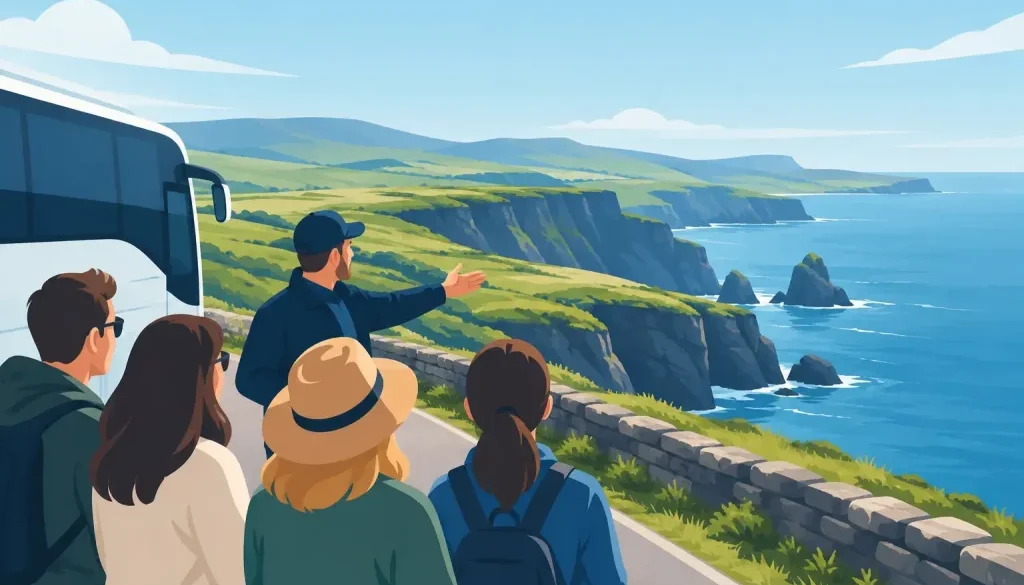
But Ireland’s Atlantic roads ask something of the driver. They can be narrow, winding and busy in summer, with stone walls close at hand and sheep displaying a cheerful disregard for timetables. The person at the wheel is often concentrating too hard to notice the very scenery they came to see. A guided tour gives everyone permission to look out of the window.
More importantly, it brings judgement to a coastline of astonishing choice. There are famous sights worth their reputation, but there are also quieter places where the day can become personal: a holy well tucked behind a village, an abandoned settlement above the shore, a graveyard whose inscriptions tell of lives carried to Glasgow, Boston and beyond. The best route depends on the season, the weather, your walking appetite and what draws your curiosity. There is no virtue in ticking off every peninsula if one landscape deserves a longer conversation.
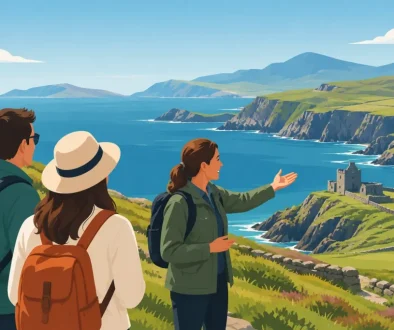
A driver-guide also provides the local texture that no satnav can offer. Why does one place-name appear in Irish and English? Why is a lighthouse positioned where it is? Why might a small harbour matter in the story of the Spanish Armada, wartime neutrality or Atlantic migration? These are not decorative details. They allow the landscape to speak in its own voice.
The coast is richer when you hear it
The western seaboard is a place of sound as much as sight. There is the roll of surf beneath sea stacks, but also the cadence of Irish place-names, the lilt of a local voice, a fiddle tune, a ballad and the sudden quiet of a peatland road. A thoughtfully guided journey can use music, poetry and recorded testimony not as background entertainment, but as a way into the country.
Listen to a traditional song near the coast and it may reveal a whole social history: work, courtship, departure, loss and the sea as both livelihood and threat. Hear a poem in the place that prompted it, and the words acquire weather. This is especially true in Donegal, where Gaelic culture, mountain country and Atlantic light meet with uncommon force.
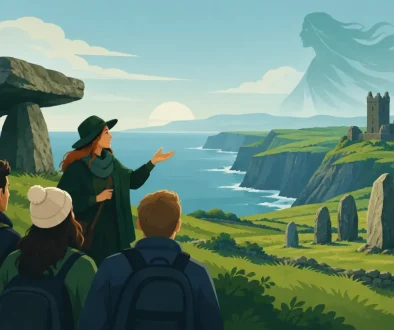
The same applies to Ireland’s sacred landscape. A lonely early-Christian site can appear modest at first glance: a cross, a ruined chapel, a holy well, perhaps a graveyard facing the ocean. With context, it becomes part of a long conversation between older beliefs, Christianity, pilgrimage and the physical drama of the land. The sacred isle is rarely announced with a grand signboard. Often, it asks for a little patience and a story well told.
Choose the right pace, not the longest route
The Wild Atlantic Way runs for well over 1,500 miles. Treating it as a single task to be completed quickly is an excellent way to see a great deal of road and remember rather less of Ireland. For most visitors, a focused region makes for a better holiday.
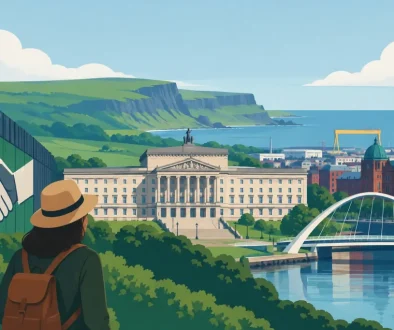
Donegal and the north-west reward several unhurried days. Here, the Atlantic feels raw and immediate, while the cultural layers run deep: the Irish language, island traditions, weaving, emigration, famine history and the complicated relationship between the Republic and Northern Ireland are all close at hand. A journey can move from the cliffs of Slieve League to Glenveagh’s wild interior, from a music-filled pub to a headland associated with ancient legend, without becoming a race against the clock.
Further south, the Mayo and Connemara coast offers bog, mountains, islands and powerful stories of survival. Clare and Kerry bring some of the route’s most celebrated views, alongside monastic settlements, literary associations and a landscape shaped by farming, fishing and tourism itself. Each region has its own character. Kerry may suit those wanting dramatic mountain passes and well-known landmarks; Donegal often appeals to travellers seeking space, depth and fewer crowds.
Weather deserves a vote in the plan. Atlantic rain is not a design flaw. It gives the hills their luminous green and the waterfalls their confidence. Still, a sensible guide reads the conditions and adjusts: a cliff walk on a clear morning, perhaps, then a museum, a fireside lunch, a traditional music stop or a historic town when the cloud comes down. Flexibility is not a compromise. On this coast, it is wisdom.
What to look for in a guide
Not every guided experience is the same. A large coach tour can offer efficient transport and a quick introduction to the headline locations, which may be exactly right for travellers on a tight schedule. But it usually has limited room for detours, conversation or changing the day when a particular interest catches fire.
For couples, families and friendship groups who want more than a commentary through a microphone, small-group or private touring has a different quality. Look for a guide who listens before they begin talking. If you are fascinated by Irish political history, genealogy, Yeats, folklore, traditional music or early Christianity, your day should bend towards that interest where possible.
Comfort matters too. A long day in the west is more pleasurable in a well-kept vehicle with room to relax, and with somebody else managing parking, navigation and the awkward business of meeting an oncoming lorry on a narrow lane. Yet luxury need not mean insulation from place. The finest tours combine comfort with the freedom to step into a field, walk a beach or stand quietly by a ruined church when the moment calls for it.
At Racontour, that balance lies at the heart of the day: carefully planned travel, intimate local knowledge and storytelling shaped around the people in the vehicle. The aim is not to perform Ireland at visitors, but to share it with them.
Questions worth bringing with you
Come with interests rather than a fixed checklist. Perhaps your grandparents left from an Atlantic port. Perhaps you have read Seamus Heaney, Brian Friel or W. B. Yeats and want to understand the ground beneath the writing. Perhaps the politics of partition, the endurance of the Irish language or the old folk beliefs around wells and fairy forts has caught your attention.
These questions create better journeys. Ireland’s history is not neatly divided into museum periods. The famine may arise beside an abandoned village; the Troubles may be part of a border landscape; a Gaelic song may preserve a memory that official history overlooked. A sensitive guide will make such connections accessible without flattening their complexity or turning hardship into spectacle.
Bring proper footwear, a waterproof layer and enough curiosity to allow the day to change. The Atlantic is a poor servant to rigid schedules, but a magnificent host to those willing to pay attention. Somewhere between the grand cliff and the small roadside story, you may find that the coast has stopped being a view and become a place you carry home.