Irish Folklore Tours That Let Old Stories Speak
A bend in a Donegal road, a ruined church above the tide, a hawthorn tree left standing in the middle of a field: these are not simply picturesque stops. On the right day, and with the right story, they become thresholds. Irish folklore tours are at their best when they treat the country’s old tales not as ornaments pasted onto a holiday, but as a living way of reading the landscape.
Ireland has never kept its stories tidily in books. They have travelled by fireside conversation, song, prayer, warning, gossip and a good deal of cheerful exaggeration. A local may tell you why nobody interferes with a particular fairy tree, then give a practical shrug and say that, whatever one believes, it has done no harm to leave it alone. That mixture of reverence, humour and common sense is part of the glory of the story.
What Irish folklore tours can reveal
Folklore is sometimes mistaken for a parade of leprechauns, banshees and misty Celtic clichés. Those figures have their place, of course, but the real territory is far richer. It includes the stories people used to explain a dangerous sea, an unexpected illness, a strange light on the mountain or the persistence of grief after a death. It holds memories of saints and holy wells, heroes and giants, changelings and otherworldly music. It also contains local knowledge, moral argument and sharp observations about human nature.
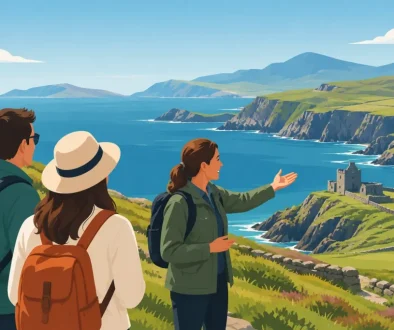
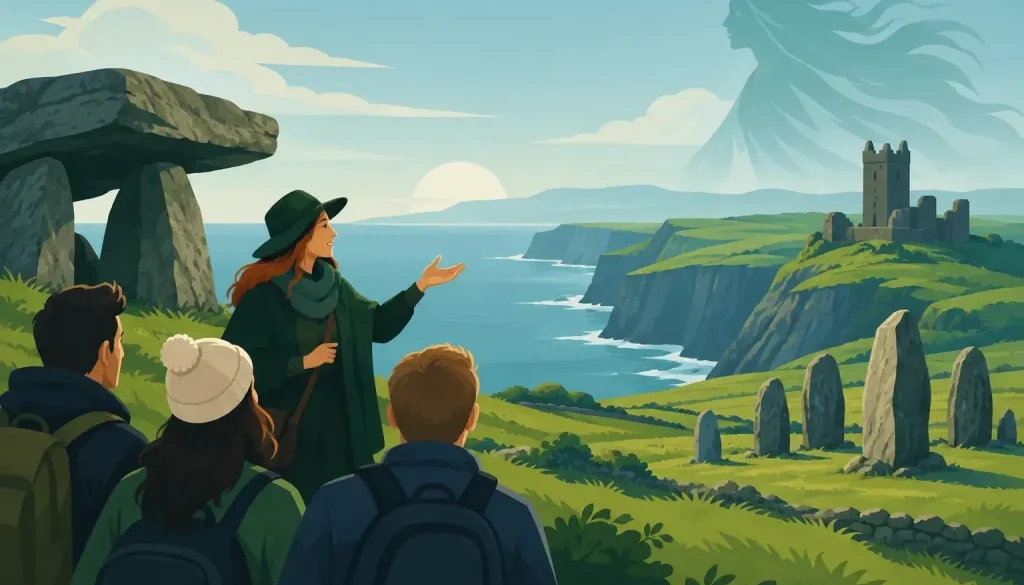
A fine guide does not announce a legend and then hurry everyone back to the vehicle. They let the place do some of the talking. Stand near a holy well and the story of a saint becomes connected to water, healing and the long habit of pilgrimage. Look across the Atlantic from a headland and tales of merrows, drowned sailors or phantom islands make emotional sense. On a hillside marked by ancient monuments, the Tuatha Dé Danann cease to be decorative names from mythology and become part of an older imagined geography.
This is why the landscape matters so much. Folklore does not float above Ireland like a souvenir-shop shamrock. It is rooted in particular townlands, glens, islands, roads and shorelines. Move twenty miles, and the same story may acquire a different hero, a new ending or a more convincing witness.
The difference between a story and a performance
There is nothing wrong with entertainment. Ireland has always prized a lively yarn, and any traveller who claims not to enjoy a ghost story in an old pub may be protesting a little too much. Yet the strongest folklore experiences balance theatre with care. A guide should know when a tale is a medieval literary tradition, when it was collected from oral storytellers, and when it is a modern invention with suspiciously excellent marketing.
That distinction does not drain the magic from the experience. It gives the magic a backbone. The story of Cú Chulainn means something different when you understand the heroic world from which it emerged. A fairy path becomes more intriguing when placed alongside the social history of rural Ireland, where respect for the unseen could sit quite comfortably beside Catholic devotion and hard agricultural labour.
It also helps to acknowledge that folklore is not frozen in the past. Families still tell stories. Musicians still carry old airs into new settings. People continue to visit wells, leave offerings and avoid disturbing lone whitethorn trees. Some practices are deeply held, others are playful, and many sit somewhere in between. A good tour makes room for that ambiguity rather than demanding a neat answer.
Where the old stories still have their footing
Donegal is especially rewarding for travellers drawn to folklore because the terrain retains such dramatic authority. The mountains, bogs, sea cliffs and offshore islands make a persuasive stage for stories of giants, shape-shifters and restless souls. In the Gaeltacht areas, Irish language and local tradition add further texture, though visitors need not speak a word of Irish to feel the force of the place.
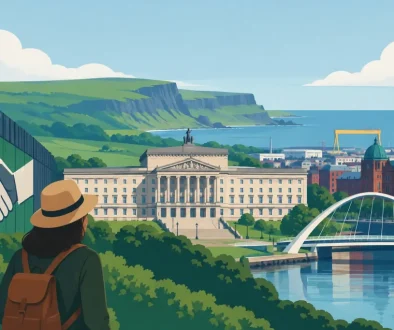
Northern Ireland offers another kind of richness. The Giant’s Causeway is associated with Fionn mac Cumhaill, whose quarrel with the Scottish giant Benandonner has survived in countless tellings. It is a splendid tale, particularly when the basalt columns are shining after rain, but it is more enjoyable when set alongside the geology and the wider Fenian cycle. Myth and science need not wrestle for ownership of the coast. They can be very agreeable travelling companions.
The west has its own powerful claims. Connemara’s lakes and mountains invite stories of loss, exile and the otherworld, while the Burren’s bare limestone and ancient monuments offer a different sort of mystery. In Kerry, Skellig Michael brings together pilgrimage, monastic endurance, seabirds and the elemental Atlantic. Each region has its own character. A traveller with a passion for sacred sites may find a quieter inland route more satisfying than a race between famous viewpoints; someone drawn to heroic legend may prefer the north-east and Ulster cycle country.
Islands, wells and the Atlantic edge
The most memorable moments are often not the headline attractions. They may be a pause beside a well with strips of cloth tied nearby, a small graveyard where local memory has outlived the inscriptions, or a ferry crossing when the weather makes the sea feel less like scenery and more like a presence.
These places ask for time. A packed itinerary can collect names but cannot create the space in which a story settles. Weather matters too. A soft day may suit a woodland tale beautifully, while a hard Atlantic wind lends conviction to every account of shipwreck, selkie and sea spirit. Ireland is generous with atmosphere, though not always with sunshine, so proper footwear and a willingness to meet the elements are part of the arrangement.
Choosing a folklore tour with substance
The best choice depends on what you hope to bring home. A short walking tour in a historic city can be ideal for a first evening in Dublin, Derry or Belfast, especially if you enjoy folklore alongside political and social history. A private driving tour is better suited to travellers who want to reach remote places without the bother of narrow roads, changing weather and navigation. It also allows the day to follow a conversation: linger at a sacred site, alter the route for a literary interest, or stop when a view insists upon it.
Small groups have their own pleasures. They can create the old-fashioned sociability of shared travel, provided the group is genuinely small and the guide has room to respond to people rather than recite at them. Large coach excursions may offer convenience and value, but folklore is easily reduced to a brisk anecdote between car parks. If your interest is serious, look for time in the itinerary, not merely a long list of stops.
Ask whether the guide can connect stories to history, place and living culture. Ask whether the experience includes walking on uneven ground, and whether it can be shaped around interests such as music, archaeology, genealogy or literature. A good cultural guide will welcome those questions. At Racontour, the journey may also include archival voices, poetry and carefully chosen music, because sometimes an old song carries a landscape further than a lecture ever could.
Listen for the local version
One of the great pleasures of travelling through Ireland is discovering that certainty is not always the point. You may hear two versions of the same legend before lunch. One will be grander, one funnier, and both may be offered with complete confidence. Resist the urge to demand a final, official edition. Folklore has lasted because it changes hands.
That is also why respect matters. Sacred places are not stage sets, and local beliefs are not props for a photograph. Walk lightly, ask before taking pictures where offerings or private devotions are involved, and accept that some stories are best heard rather than extracted. The reward is a more generous encounter with the country and its people.
Choose a route with room for a detour, a conversation and a patch of rain on the windscreen. Somewhere beyond the famous view, an old story is waiting for the right listener.