A Northern Ireland Political History Tour
A Northern Ireland political history tour is not a roll-call of dates, murals and grim statistics. It is a journey through places where identity has been argued, defended, celebrated and mourned – often on the same street. Done well, it gives visitors the confidence to ask difficult questions, hear more than one account and leave with a sharper sense of how history remains present in daily life.
For the curious traveller, this is part of the glory of the story. Northern Ireland is not an open-air museum of the Troubles. It is a living place of startling creativity, humour, music, industry and hospitality. Political history is one thread in a much larger tapestry, but it is a thread that helps explain the flags, the parades, the carefully chosen names and the powerful silences.
What makes this history different
The conflict commonly called the Troubles was not an ancient feud that erupted from nowhere. Its roots reach into centuries of plantation, dispossession, religious division, union with Great Britain, resistance to British rule and competing national ambitions. By the late 1960s, civil-rights protests against discrimination in housing, voting and employment met with a fierce and often violent response. Over the following three decades, republican and loyalist paramilitaries, the British Army, police and political leaders all shaped a conflict that claimed more than 3,500 lives.
That sentence is factual, but no sentence can contain the human cost. A thoughtful tour makes room for individuals: the family leaving a street after an attack; the soldier far from home; the shopkeeper opening the shutters after another uneasy night; the campaigner who refused to accept second-class citizenship; the parent who still does not know the full circumstances of a loved one’s death.
Words matter here. One person may speak of “Londonderry”, another of “Derry”. One may call 1969 a period of unrest, another the beginning of war. A good guide does not smooth away those differences for the comfort of the visitor. Nor should they turn them into theatre. The aim is to understand why language, memory and place carry such weight.
Belfast: the walls, the words and the working city
Belfast is often the natural starting point for a Northern Ireland political history tour. It was a mighty industrial city, built on linen, rope-making, engineering and shipbuilding, long before it became internationally associated with conflict. That earlier story matters. It tells us why working-class communities, concentrated in neighbouring districts, could develop such strong local identities and such deep anxieties about political change.
The Falls Road and Shankill Road are rightly known for their murals, memorials and political symbolism. Yet they are not interchangeable galleries. The Falls is closely associated with the nationalist and republican tradition, while the Shankill is associated with unionism and loyalism. To pass through them at speed, taking photographs from a vehicle, is to miss the point. The murals are arguments in paint: about Ireland, Britain, sacrifice, prisoners, war, community and remembrance.
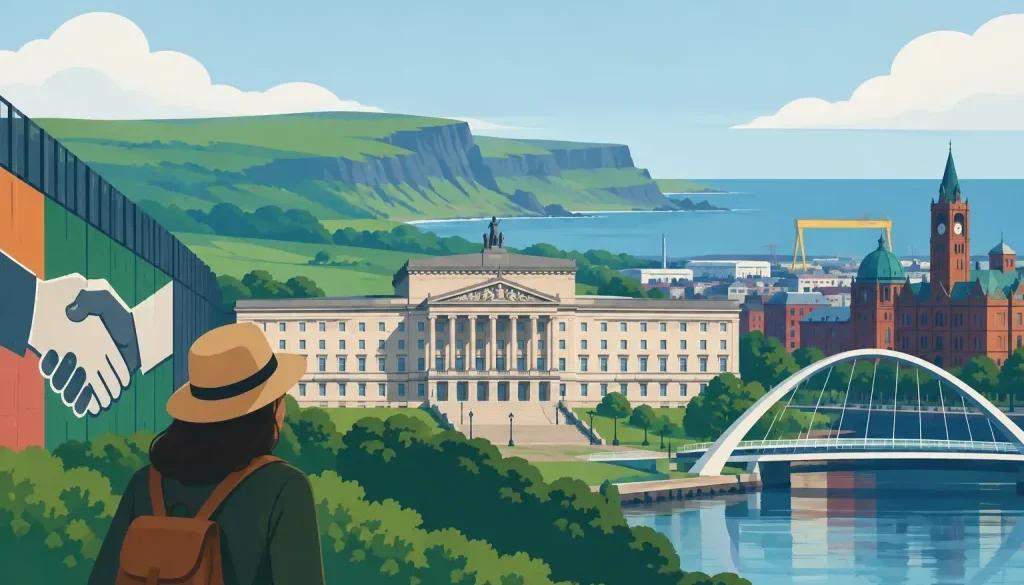
The peace walls are equally complex. Built to separate communities during periods of violence, they can feel startlingly physical to visitors who imagine peace as a clean final chapter. Gates may still close at night in some areas. At the same time, people work, study, shop and socialise across old divisions every day. Northern Ireland has changed enormously since the Good Friday Agreement of 1998, but the landscape does not pretend that reconciliation is simple.
A visit to Stormont adds another necessary dimension. The grand Parliament Buildings, set above the city, recall the creation of Northern Ireland in 1921 and its devolved government. They also bring the story into the present, where power-sharing, constitutional questions and debates about identity remain central to political life. History is not parked behind a velvet rope here.
Beyond Belfast: Derry, the border and the wider picture
Derry is indispensable. Its seventeenth-century walls, remarkably intact, offer a dramatic stage on which several centuries of history can be read. The city is central to the story of the Plantation of Ulster, the Siege of Derry, partition, civil-rights activism and Bloody Sunday in 1972, when British soldiers killed 13 unarmed demonstrators and mortally wounded another.
A careful walk through the Bogside should never feel hurried. The murals there are moving public art, but they are also part of a community’s testimony. Nearby, the Guildhall and the city walls make clear that Derry contains overlapping stories, not a single approved narrative. This is precisely what makes it such a compelling place to visit.
Then there is the border. On a map it can appear as a neat line between Northern Ireland and the Republic of Ireland. On the ground, it twists through lanes, fields, villages and family histories. During the Troubles it was heavily militarised in places, with watchtowers, checkpoints and cratered roads. Today, its relative invisibility is one of the most tangible achievements of the peace process.
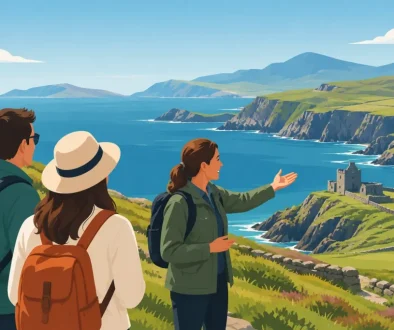
For visitors travelling through counties Armagh, Tyrone, Fermanagh or along the Donegal frontier, the border story brings big constitutional questions down to human scale. Which school did children attend? Which town did a family shop in? Which route became dangerous after dark? The answers were rarely abstract.
How to travel with curiosity and care
There is no requirement to arrive as a scholar. Indeed, the best visitors bring curiosity rather than a suitcase full of fixed opinions. Read a little beforehand if you wish, but allow the places themselves to complicate what you think you know. A good day on the road will leave room for questions, pauses and the odd change of plan prompted by weather, conversation or a local event.
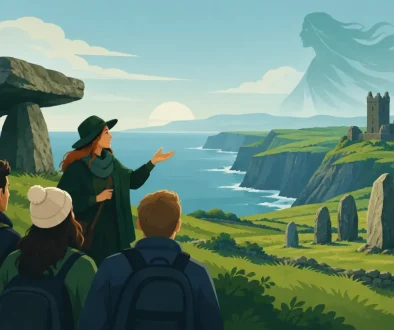
It is worth choosing a guide who can provide historical structure without flattening the story into two opposing teams. The best guiding combines the major landmarks with the details that do not make the headlines: an old factory gate, a memorial garden, a changed street name, a song remembered from childhood. At Racontour, that may include archival voices, poetry and music alongside the landscape itself – a sound and vision extravaganza, certainly, but always in service of the story.
Photography deserves a little thought. Most public murals and streets can be photographed respectfully, but memorials are places of remembrance, not props. Ask before photographing people, avoid lingering outside homes, and remember that communities are not exhibits. The same courtesy applies to conversation in pubs and cafés. Listen first. A local person may be happy to share an opinion, but they do not owe any visitor a political tutorial over a pint.
Timing also matters. The marching season around July can be fascinating for those wishing to understand unionist and loyalist culture, particularly the traditions surrounding the Twelfth. It can also be busy, emotionally charged and disruptive to routes. For some travellers it is exactly the right time to visit; for others, a quieter season allows for more unhurried conversation. It depends on what you hope to learn and how much intensity you want in a day.
Peace is a process, not a postcard
The Good Friday Agreement transformed Northern Ireland. It created a framework for power-sharing, recognised the legitimacy of different constitutional aspirations and helped end the worst violence. It did not require people to forget. Nor did it make grief disappear, settle every question of justice, or erase the neighbourhood boundaries built over generations.
That is why political history touring here can be so valuable. It replaces the lazy shorthand of “old hatreds” with a richer account of political decisions, social conditions, courage, fear and ordinary lives. It also reveals a society that has produced extraordinary artists, writers, musicians and community leaders while carrying a difficult inheritance.
Take your time. Let the murals speak, but also notice the school run, the football shirts, the cafés, the cranes on the Belfast skyline and the rain clearing over the Fermanagh hills. Northern Ireland rewards the traveller who comes not to collect a conflict, but to listen for the many voices still shaping its future.