Donegal Private Tour Guide for Stories and Scenery
A Donegal private tour guide earns their keep long before the first photograph is taken. This is a county of vast horizons, sudden weather and roads that seem to wander off in search of a better story. The right guide makes sense of it all: why a ruined church sits above a silver strand, why a mountain pass carries the echo of an old rebellion, and why the music in a modest village pub may tell you more about the place than a shelf of guidebooks.
Donegal is not a place to be hurried. Its great pleasures often lie between the celebrated landmarks: the old man who remembers a local poet, the turf smoke drifting from a cottage, the change in the Atlantic light as you round a headland. Private touring gives those moments their proper value. There is no coach timetable barking at your shoulder, no need to keep one eye on the road, and no obligation to admire every stop in precisely twelve minutes.
What a Donegal private tour guide brings to the journey
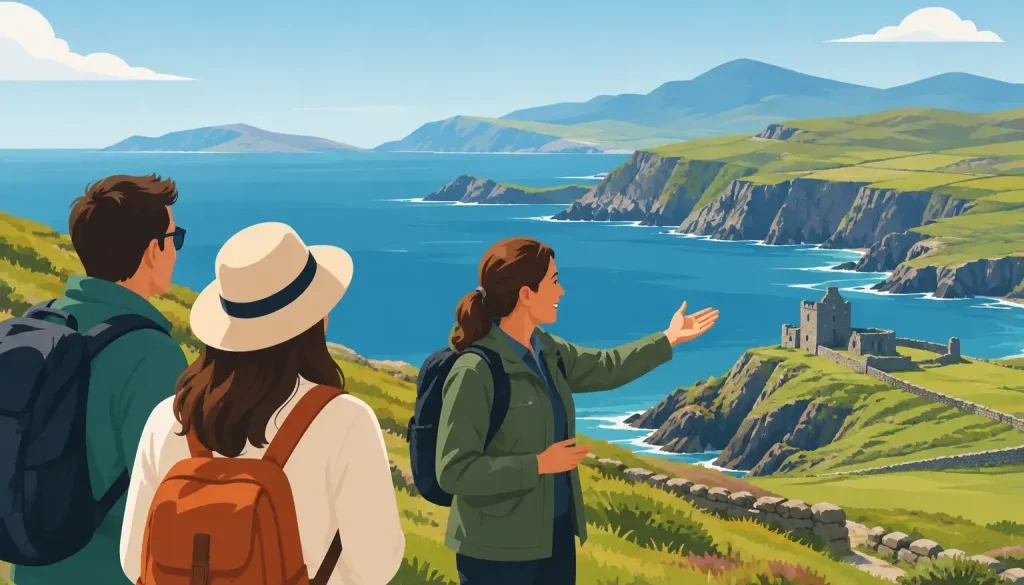
A good day in Donegal is not simply a string of scenic pins on a map. It has shape, pace and a little surprise. Your guide should know when to begin with a grand view and when to leave the car for a short walk into a quieter corner of the landscape. More than that, they should be able to read the day and the people in front of them.
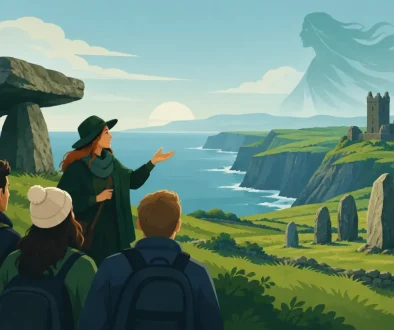
For some visitors, that may mean tracing family roots through a parish, townland or emigrant story. For others, it is a day of dramatic coastline, sheep-dotted hills and a lunch worth remembering. A literary-minded traveller might want the world of Patrick MacGill, the Glenties of Brian Friel, or the landscapes that fed generations of Irish song. Another group may be drawn to the island’s sacred inheritance, its early Christian sites and the sturdy, wind-tested faith of the north-west.
The distinction matters. A driver can take you from A to B. A cultural guide can turn the road itself into part of the experience. In Donegal, where history has often survived in local memory rather than on a polished interpretation board, that difference is considerable.
Donegal is better understood at a human pace
The county is larger and more varied than many first-time visitors expect. Malin Head, Glenveagh, Slieve League, Ardara, the Inishowen Peninsula and the Gaeltacht each deserve attention, but attempting to conquer them all in one sweep is the surest route to seeing very little.
Private touring allows for sensible choices. From Letterkenny, Inishowen may make perfect sense for a day of forts, famine history, the northern shore and the wild final reach of the island at Malin Head. From Donegal Town, the south-west can lead towards the towering sea cliffs at Sliabh Liag, Glencolmcille and the brooding coast beyond. If your base is Ardara, the story may turn towards handwoven tweed, music, mountain roads and the coastline of south Donegal.
There are trade-offs, naturally. A private guide will help you cover more ground comfortably than self-driving, but no amount of local knowledge can make distant points magically adjacent. Donegal rewards a well-chosen region, not an ambitious assault on the entire county. Better to have time for one proper walk, one unplanned conversation and one fine view in changing light than to spend the day fastening and unfastening a seatbelt.
Weather is part of the performance
Donegal weather is not a minor logistical detail. It is one of the great artists of the place. A bright morning can become a theatrical Atlantic squall by lunchtime, while rain can draw extraordinary colour from the heather and leave rainbows standing over a valley like public art.
An experienced guide plans with alternatives in mind. If cloud settles heavily on the high ground, a coastal route, a museum, an old church, a craft visit or a music-rich village may offer a better day than stubbornly waiting for a view that refuses to appear. Equally, when the sky clears, there is value in changing course and making for the headland. Flexibility is not an add-on in Donegal. It is part of travelling wisely.
The glory of the story behind the view
Donegal’s scenery has a magnificent habit of looking ancient and untouched. Yet almost every valley, cliff and island shore has been shaped by human lives: by fishermen, Irish speakers, weavers, clergy, migrants, rebels, landlords and families who made a living from unforgiving ground.
Take the west coast. The cliffs are splendid, certainly, but they become more affecting when you understand the patterns of seasonal migration, the harsh economics of the nineteenth century and the persistence of communities at the very edge of Europe. In the Gaeltacht, language is not a souvenir. It is a living inheritance, carrying a particular way of naming the weather, the sea, the hills and the people who belong to them.
Then there is the political history. Donegal sits beside Northern Ireland, close to a border that has shaped trade, identity, family life and movement for generations. A thoughtful guide can discuss this history with balance and clarity, without turning the day into a lecture or skirting the difficult bits. The landscape is beautiful, but it has never been empty of consequence.
At Racontour, that cultural thread may be carried by a line of poetry, an archival voice, a local recording or a carefully chosen piece of Irish music. It is not background noise. Sound has a way of bringing a place close. A fiddle tune heard while travelling through the hills can stay with you long after the mileage has faded.
Comfort, conversation and the freedom not to drive
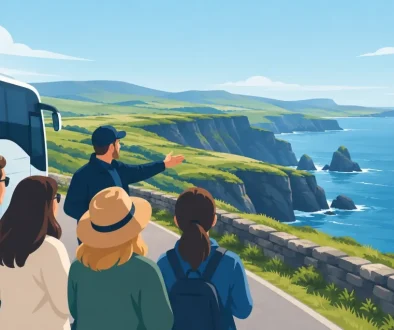
For many visitors, the practical case for private guiding is wonderfully straightforward. Narrow roads, unfamiliar driving conditions and a lively Atlantic forecast are not everyone’s idea of a relaxing holiday. Sitting back in a comfortable vehicle means everyone can look out of the window, share a dram of local knowledge and arrive without the low-grade strain of sat-nav disagreement.
It also makes room for conversation. Donegal is full of questions that deserve more than a hurried answer. Why are there so many ruined cottages on certain hillsides? What is the difference between a townland and a village? How did tweed become part of the county’s identity? Who were the people commemorated on that memorial? A private guide can follow the thread that catches your interest, whether it leads towards folklore, archaeology, music or family history.
This is particularly valuable for couples and small groups with mixed enthusiasms. One person may have arrived for the scenery, another for Irish history, a third for a decent lunch and a good local pint. There is no reason a well-made day cannot accommodate all three. The finest itineraries have enough structure to feel purposeful and enough elasticity to let the place have its say.
Choosing the right guide for Donegal
When considering a private guide, look beyond a list of destinations. Ask what kind of experience is being offered. Is the day built around a fixed route, or can it be tailored to your interests and mobility? Will there be time for gentle walking, or is the emphasis on a chauffeur-driven overview? Does the guide understand the local history deeply enough to distinguish legend from fact while still enjoying the legend?
It is also fair to ask about vehicle comfort, collection points, likely journey times and weather contingencies. Premium private touring should feel easy, but ease is usually the result of careful planning. If you have particular interests, mention them early. A guide who knows that you care about Irish-language culture, sacred sites, the Troubles, genealogy or traditional music can shape the day with much greater imagination.
Above all, choose someone whose company you will enjoy. You are not hiring a talking sat-nav. You are inviting a companion into your holiday, someone who should know when to tell a grand tale, when to offer a useful practical tip and when to let the Atlantic do the talking.
A day in Donegal need not end with a checklist completed. Let it end with a story you did not expect to hear, a road you would never have found alone, and the pleasant feeling that this sacred isle has revealed just a little more of itself.