DISCLAIMER: As a rule, the Irish do not feel comfortable “bigging” themselves up. We see it as having “notions” above our station! Anyone inclined to do so will usually be brought back down to Earth very quickly with some heckling. So with apologies to my fellow Irish, both living and dead, please excuse me while I tell the world how great I am – or at least hint strongly at it.
I’ve an eclectic range of skills and hope that they at least show I’m not completely spoofing when I say I know a bit about X or Y. Chances are I do and the best place for me is out on the road, sleeves rolled up about to tell them a tale connected to the landscape they are driving through. That to me is one of the great treats of the job.
Attributes I bring to each and every tour are the three Cs: courtesy, charm and curiosity. Add in humour, punctuality and attention to detail. Definitely getting “notions” here! Right then, on with the show…
Very diligent and reliable
Jack Ward worked for this company for the Summer Season from April to September 2023 as a Driver Guide. During his time working with us we found him always to be a good worker, easy to deal with, very diligent and reliable. He also never had an accident or an incident while driving with us, and he got positive and good feedback from passengers.
Jack made a point of getting to know a bit about each of us, which was a wonderful ice-breaker. His engaging manner and sense of humour put everyone at ease. As we travelled to each stop Jack told us about the history, the people, the myths and legends of the area, and played evocative music. It was an incredible multi-sensory experience!
Karen Langen
Engineer/tourist
Canada
One of the best tours in 40 years of travel
We had a remarkable introduction to Ireland, thanks to Jack Ward, our outstanding guide for those days. He peppered his well-informed commentary with a soundtrack of music and spoken word that brought to life the places and people. It was one of the best guided tours I have had in more than 40 years of international travel.
Mary Ann Bacher
Journalist/tourist
New York
Above and beyond
Jack Ward went above and beyond to make our 5 day tour of Northern Ireland and the Atlantic Coast magnificent! His charisma and knack for storytelling along with his vast knowledge and zeal for Irish history and folklore brought this beautiful and ancient land uniquely to life! He’s an absolute gem!
Gerann Murphy
Developer/tourist
Canada
Energetic, enthusiastic and passionate
Jack was such a gift. Not only was he an extremely knowledgeable, engaging historian and storyteller (understatements to be sure), he was energetic, enthusiastic and passionate. He went above and beyond, for all of us. The members of this tour had very different personalities and interests. Jack made every effort to accommodate all of our needs and requests, which was no easy task. Thank you Jack!
Sheri Ann Donegan
Supreme Court Justice/tourist
British Columbia
A first-class experience
Jack has the characteristics that I value in a great guide – discussion in a frank, detailed, comprehensive, articulate manner, able to address real and challenging topics, in a balanced and respectful manner, with an astute wit. He is knowledgeable of the history and politics of Ireland, with the special and unique bonus of providing a culturally curated, narrated soundtrack in the coach.
Curt LaFrance
Ivy League professor/tourist
Boston
Simply the best
Our thanks to Jack Ward for making our tour with him so very special. His commitment to ensuring a quality experience for all was evident in all respects (and so much fun)!! We continue to remember with great fondness our time with him and how special he made that part of the tour. We must say that the following guides, while fine fellows, paled by comparison.
Gordon Little
Lawyer/tourist
Colorado
His knowledge is astounding
Our tour guide, Jack Ward, was excellent. We felt like we received a custom, private tour. His knowledge of Ireland and Northern Ireland history and geography is astounding.
Terry Bavaro
Engineer/tourist
California
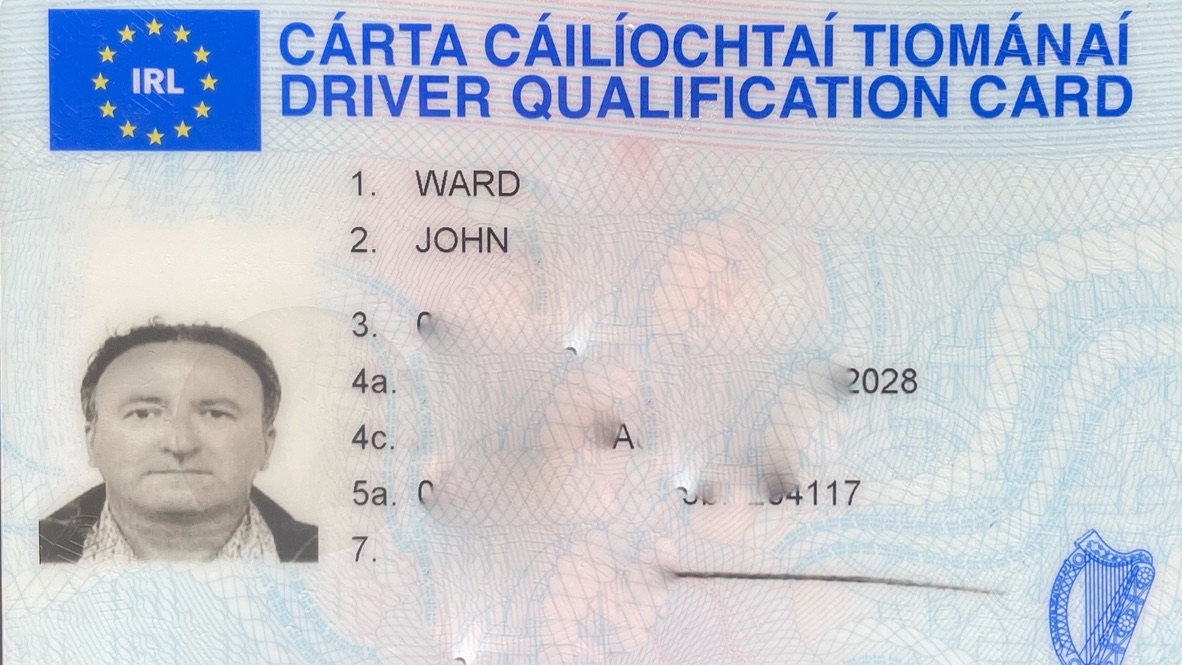
Qualifications
Nationally Accredited Tour Guide
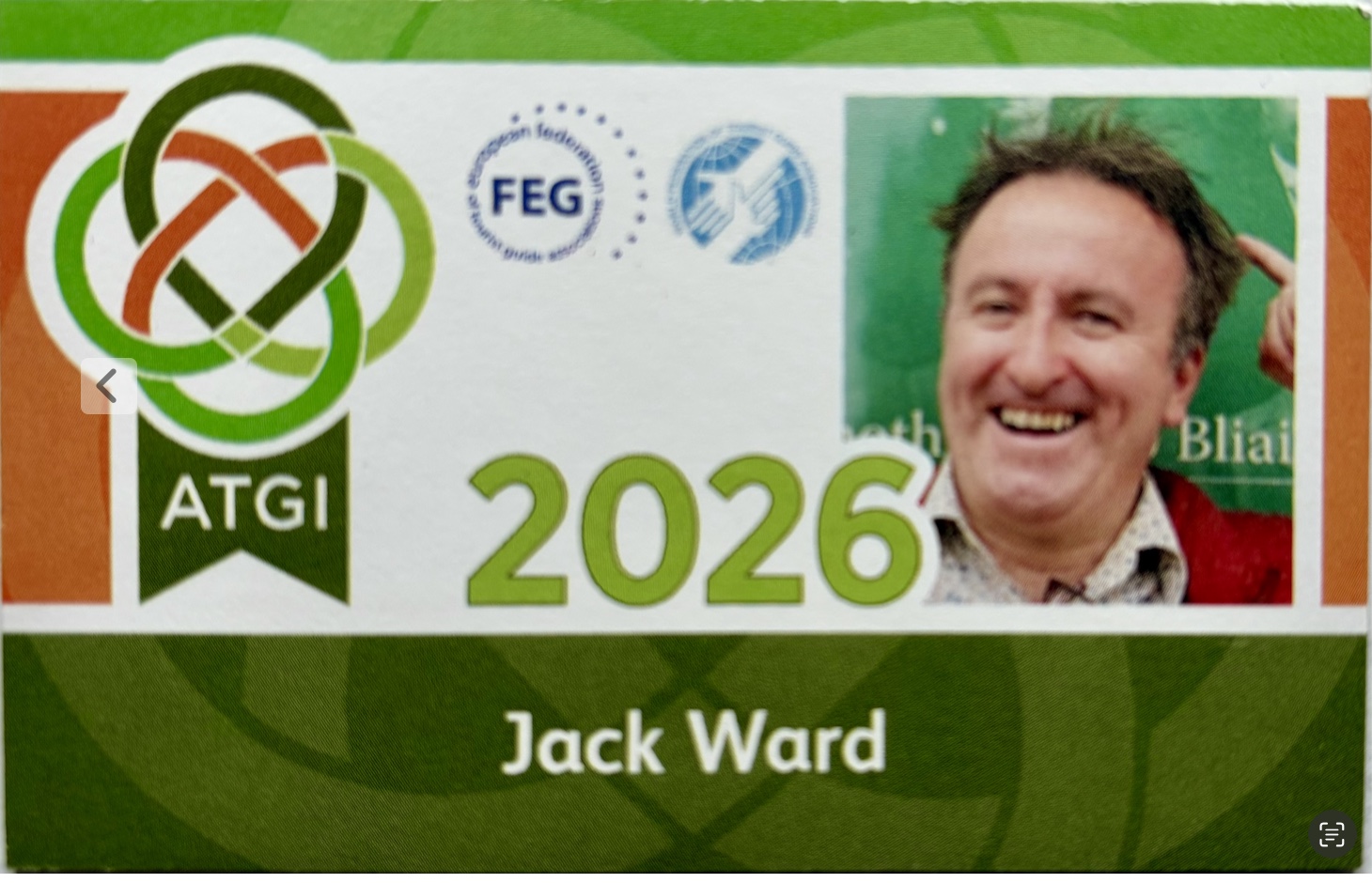
Proud Approved Tourist Guides of Ireland (ATGI) Member. I have been awarded the National Tour Guiding Special Purpose Award. This means I’m qualified to lead tours around the whole of Ireland.
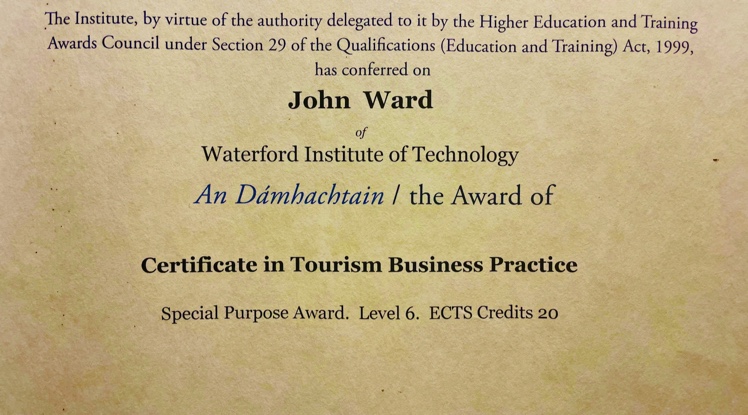
The QQI Level 6 tour guiding qualifications I’ve received are in the areas of:-
National Tour Guiding
Irish National Heritage and Culture
National Tour Management
Tourism Proficiency
Run by the national tourism authority, Fáilte Ireland, and awarded by what is now the South East Technological University (formerly W.I.T) I successfully completed this course in 2010. The course comprehensively covered all aspects in the field of running a tourism business.
I specialised in tourism and travel service marketing as I sought to bring more tourists to north Donegal via an innovative piece of technology. Based on my submitted project, I was shortlisted as one of nine finalists for the Business Challenge Awards – and was the only one in digital media.
Cultural Heritage commentator
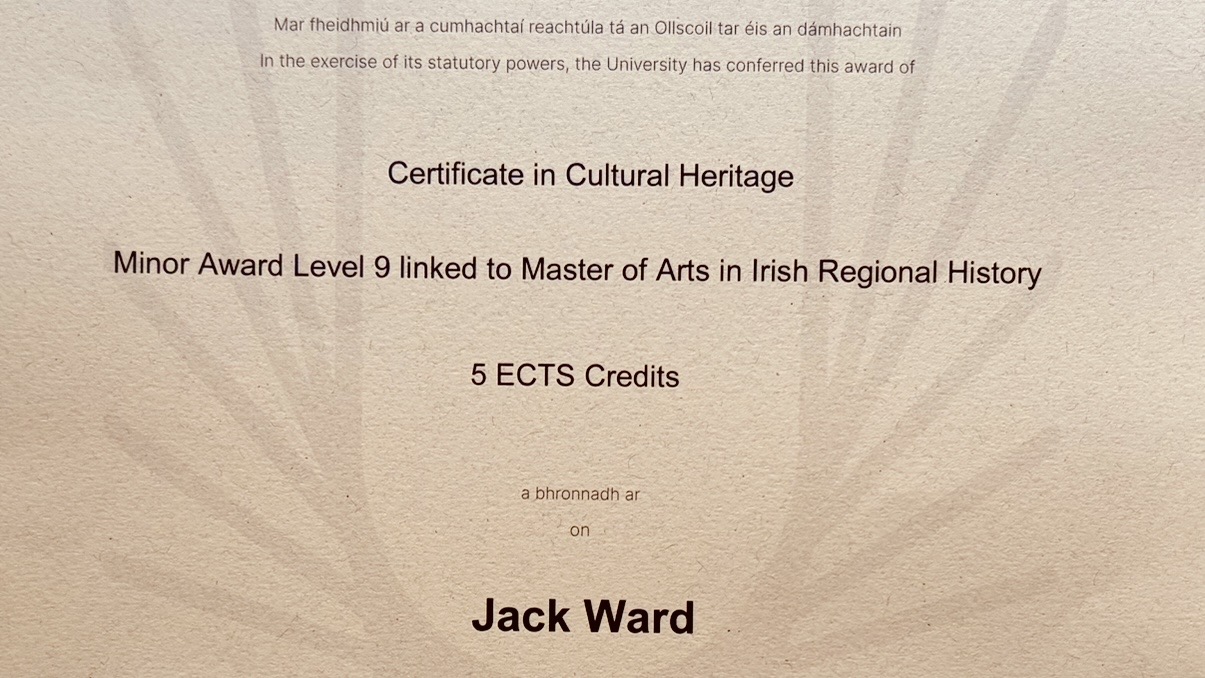
In 2025, I started a course in South East Technological University to gain a greater understanding of cultural heritage. The result was a Certificate in Cultural Heritage gained from a blended-learning course focused on regional Irish heritage.
To quote the university itself, it covered “both tangible (monuments, artifacts) and intangible (folklore, traditions) aspects, aimed at professionals in history-related fields or those seeking to explore local heritage from a theoretical perspective”. Though demanding, it has given me the necessary professional tools to better translate the topics I deal with on tour.
Irish Studies Master
I’ve been interested in Irish history and literature for years. Many of the pieces in the Blog of this website relate to these topics. Since the 1990’s I’ve been active in promoting both fields and was organising Heritage Weeks several years before the Heritage Council came up with them.
On the centenary of the Easter Rising, I decided to do a Masters in Irish Studies at St. Mary’s University in Twickenham, which has a long proud record of receiving Irish undergraduates. New Perspectives in Irish History and Modern Irish Literature were two of the core modules. I’m happy to take a discussion to an academic level if required!
Qualified Oral Historian
As both an audio archivist and radio producer, I have accumulated a lot of original recordings around Ireland. They are freely available on my racontour.com website. This wisdom adds a further layer to my skillset in that the information provided is aural and told with a passionate and authenticity that no book can ever match.
Recording these various raconteurs over the years has also added to my own ability to tell a story to an audience as deft and succinctly as possible. For an island known for its storytelling, this does give me a competitive edge. I’m able to use the best material via Spotify when on tour adding an extra layer to the tourist’s enjoyment of the landscape.
Retired Solicitor
Believe it or not, this professional qualification is one that adds greatly to being a tour guide. It manifests itself in being a stickler for detail and ensuring that I’m on solid ground in making judgment calls on a daily basis: be it health and safety or quoting which law is in place for mandatory wearing of seat belts!
It is also good for the tourist in a range of areas from advising them of the tax refund scheme, customs clearance for the USA at Dublin and Shannon or explaining the broadbrush details of legal documents from the Good Friday Agreement, the 1937 Constitution or indeed the controversial Legacies Act in place (for now) in Northern Ireland.
Folklorist
I’ve been fascinated with Irish folklore for over 40 years. To understand the Irish, one has to know about this great oral tradition. A lot of the material you will find in my audio archive relates to folklore – from fairy lore to superstitions. My Rambling House series features significant vernacular material. In recent times, I’ve added to that with material with the addition of the Celtic Calendar relating to the lore surrounding the four cross-quarter days in Ireland.
I’m a paid-up subscriber to Béaloideas, the Journal of the Folklore of Ireland Society. See the Blog section for more material on this fascinating topic or go to The Twilight Court, my musical comedy based on Irish folklore.
Storyteller
For all the qualifications in the world, if I can’t open my mouth and tell a yarn, then this page ‘ain’t worth a pitcher of warm spit’ as some great sage once said. That same fellow also said that speaking in public is ranked even higher than a fear of death. And boy, did I once fear both back in my twenties, but no more; ‘not with the fire in my belly now’ as yet another great sage once said.
In the accompanying video, I’m talking about Ireland’s oh-so-pious St. Kevin of Glendalough and bringing in his neighbour, the late boulevardier, Garech Browne. I was doing it to show that sometimes opposites can have plenty in common. Showing who you’re talking about helps greatly I find.
Discover the Magic of Irish Seasons: Traditions and Changes
Experience the enchanting shifts of Irish seasons, rich in traditions and cultural changes that connect the past
with the present. Discover the magic today!
Spring in Ireland: Traditions and Celebrations
As the chill of winter begins to wane, Ireland bursts into a vibrant array of colors and renewed life. Spring in
Ireland is a time of rebirth and rejuvenation. The season starts with St. Brigid’s Day on February 1st, marking
the beginning of the Celtic spring. St. Brigid, one of Ireland’s patron saints, symbolizes fertility and the
arrival of longer, warmer days. Traditionally, Irish families weave St. Brigid’s crosses from rushes, believed
to protect homes from fire and evil spirits. These crosses are hung in homes and barns, embodying the hope and
protection that spring brings.
Another significant event in the Irish spring calendar is St. Patrick’s Day on March 17th. This global
celebration of Irish culture is marked by parades, music, dancing, and a plethora of green attire. Originally a
religious holiday honoring Ireland’s patron saint, it has evolved into a celebration of Irish heritage
worldwide. Towns and cities across Ireland host parades featuring floats, marching bands, and performers, creating
an atmosphere of joy and community spirit. Traditional Irish music and dance performances are integral parts of the
festivities, drawing locals and tourists alike.
Spring also heralds the start of agricultural cycles, with farmers preparing their fields for planting. This season
is crucial for the rural communities, as it sets the tone for the year’s harvest. Traditional spring fairs and
markets spring up across the country, offering fresh produce, handmade crafts, and a taste of rural life. These
events are not only essential for the economy but also serve as social gatherings that strengthen community bonds.
The return of longer days and the blossoming countryside invigorate the Irish spirit, making spring a time of
optimism and communal celebration.
The Beauty of Summer: Festivals and Activities
The arrival of summer in Ireland is met with great anticipation and excitement. From June to August, the country
transforms into a vibrant playground of festivals, outdoor activities, and natural beauty. The summer solstice,
celebrated around June 21st, is a significant event in the Irish calendar. Historically, ancient Celts marked this
longest day of the year with bonfires and feasting. Today, people gather at ancient sites like Newgrange and the
Hill of Tara to witness the solstice sunrise, connecting with the traditions of their ancestors.
One of the most iconic summer festivals is the Galway International Arts Festival, held in July. This two-week event
features a diverse program of theatre, music, visual arts, and street performances, attracting artists and audiences
from around the world. The festival transforms the city of Galway into a bustling hub of creativity and cultural
exchange. Similarly, the Fleadh Cheoil na hÉireann, the largest traditional Irish music festival, takes place in a
different town each August, showcasing the best of Irish music, song, and dance.
Summer is also a time for exploring Ireland’s stunning landscapes. The Wild Atlantic Way, a scenic coastal route
stretching from Donegal to Cork, offers breathtaking views, charming villages, and opportunities for outdoor
adventures. Hiking, cycling, and water sports are popular activities, allowing visitors to immerse themselves in the
country’s natural beauty. Beaches, though often chilly by international standards, become hotspots for locals
and tourists alike. The blend of cultural festivities and outdoor pursuits makes summer in Ireland a season of
endless possibilities and joyful experiences.
Autumn in Ireland: Harvest and Cultural Significance
As the leaves turn to shades of gold and crimson, autumn in Ireland brings a sense of reflection and gratitude. The
season is deeply rooted in agricultural traditions, with harvest festivals celebrating the bounty of the land.
Lughnasadh, the ancient Celtic festival marking the beginning of the harvest season, is celebrated on August 1st.
Named after the god Lugh, it involves feasting, music, and games, reflecting the community’s gratitude for the
earth’s abundance. Though modern celebrations are more subdued, the spirit of Lughnasadh persists in local fairs
and gatherings.
Autumn is also the time for Samhain, the ancient festival that marks the end of the harvest and the beginning of the
darker half of the year. Celebrated on October 31st, Samhain is considered the precursor to Halloween. It was
believed that on this night, the veil between the living and the dead was at its thinnest, allowing spirits to roam
the earth. People would light bonfires and wear costumes to ward off these spirits. Today, Halloween in Ireland is a
blend of ancient traditions and modern festivities, with children trick-or-treating and communities hosting haunted
attractions and events.
The cultural significance of autumn extends to literature and the arts. The Dublin Theatre Festival, held in late
September and early October, is one of the oldest and most prestigious theatre festivals in Europe. It features a
mix of Irish and international productions, highlighting the richness of the performing arts. Additionally, the
Wexford Festival Opera, taking place in October, showcases lesser-known operas and attracts opera enthusiasts from
around the globe. These cultural events, combined with the natural beauty of the changing landscape, make autumn in
Ireland a season of introspection and artistic inspiration.
Winter Wonders: Traditions and Festivities
Winter in Ireland is a time of warmth, reflection, and festivity, despite the cold and often damp weather. The
season is marked by a series of traditions that bring light and joy to the darkest months. The winter solstice,
occurring around December 21st, has been celebrated since ancient times. At the prehistoric site of Newgrange in
County Meath, the solstice sunrise illuminates the inner chamber of the tomb, an awe-inspiring spectacle that draws
visitors from around the world. This event symbolizes the triumph of light over darkness and the promise of longer
days to come.
Christmas in Ireland is a blend of religious observance and joyous celebration. The season begins with Advent, as
homes and churches are adorned with wreaths, candles, and nativity scenes. On Christmas Eve, many attend Midnight
Mass, a tradition that underscores the religious significance of the holiday. Christmas Day is a time for family
gatherings, feasting, and exchanging gifts. Traditional foods such as roast turkey, ham, and plum pudding are
enjoyed, and the evening often ends with songs and stories by the fire.
The festive season continues with St. Stephen’s Day on December 26th, also known as Wren Day. In some parts of
Ireland, people dress in old clothes and straw masks, parading through towns while playing music and singing. This
tradition, rooted in ancient customs, symbolizes the triumph of the wren, considered the king of birds, over the
darker days. New Year’s Eve and New Year’s Day are celebrated with fireworks, parties, and resolutions,
marking the end of one year and the hopeful beginning of another. The blend of ancient customs and modern
festivities makes winter in Ireland a season of warmth and renewal.
The Role of Nature in Irish Seasonal Changes
Ireland’s seasons are profoundly influenced by its natural environment, with the landscape playing a central
role in the country’s cultural and agricultural practices. The mild, temperate climate ensures that each season
is distinct yet not extreme, allowing nature to flourish year-round. Spring’s arrival is heralded by blooming
daffodils, lambs frolicking in fields, and the gradual lengthening of days. The lush, green countryside comes alive,
reflecting the renewal and growth that characterize the season.
Summer’s warmth and extended daylight hours provide the perfect conditions for outdoor activities and the growth
of crops. The landscape is dotted with wildflowers, and the coastal regions become popular destinations for hiking,
swimming, and exploring. The fertile soil and favorable weather conditions support a diverse range of flora and
fauna, making summer a time of abundance and natural beauty. The interplay between the land and the sea, with its
rugged cliffs and sandy beaches, adds to the unique charm of the Irish summer.
Autumn’s arrival brings a transformation in the landscape, as trees don vibrant hues of red, orange, and yellow.
The harvest season reflects the culmination of the year’s agricultural efforts, with fields yielding crops and
orchards laden with fruit. The crisp air and shorter days signal a time for reflection and preparation for the
winter ahead. Winter, though often harsh with its cold winds and rain, has a stark beauty of its own. The bare trees
and snow-dusted hills create a serene, almost mystical atmosphere. The natural cycles of growth, harvest, and rest
are deeply intertwined with Irish traditions and way of life, making nature an integral part of the seasonal
experience.
Folklore and Mythology Associated with Each Season
Irish folklore and mythology are rich with stories and legends that reflect the country’s deep connection to the
natural world and its seasonal changes. Spring, for example, is associated with the goddess Brigid, a figure of
fertility, healing, and poetry. Her festival, Imbolc, marks the beginning of spring and is a celebration of new life
and the return of the sun. Legends tell of Brigid’s magical cloak, which could expand to cover vast areas of
land, symbolizing the growth and protection that spring brings.
Summer’s mythology is filled with tales of the Tuatha Dé Danann, a race of god-like beings who are said to have
brought magic and prosperity to Ireland. The festival of Bealtaine, celebrated on May 1st, honors these deities and
the start of the summer season. Fires were lit on hilltops to welcome the sun and protect against evil spirits. The
legend of Lugh, the god of light and the arts, is also central to summer celebrations. His festival, Lughnasadh,
marks the beginning of the harvest and is a time of feasting, games, and merriment.
Autumn’s folklore is dominated by the festival of Samhain, a time when the boundary between the living and the
dead is believed to be at its thinnest. This night is filled with stories of spirits, fairies, and otherworldly
beings. The legend of the Púca, a mischievous shape-shifting fairy, is particularly associated with Samhain. It was
believed that the Púca would roam the countryside, playing tricks on unsuspecting travelers. Offerings of food and
drink were left out to appease these spirits and ensure a safe passage through the dark months.
Winter’s mythology is rich with tales of the Cailleach, the divine hag of winter. According to legend, the
Cailleach is responsible for the harsh winter weather, and her reign begins at Samhain and ends at Bealtaine. She is
depicted as an old woman with a staff, capable of summoning storms and frost. The winter solstice, celebrated at
Newgrange, is also steeped in mythology. It is said that the solstice light represents the rebirth of the sun god,
bringing hope and renewal. These stories and legends add a layer of magic and mystery to the changing seasons,
reflecting the deep cultural significance of nature in Irish life.
Seasonal Foods and Culinary Traditions in Ireland
The changing seasons in Ireland bring a variety of culinary delights, with each season offering its own unique
flavors and traditional dishes. Spring’s arrival is marked by the availability of fresh, seasonal vegetables
such as asparagus, new potatoes, and rhubarb. Lamb, a symbol of spring, is a popular choice for Easter Sunday
dinner, often roasted with herbs and served with mint sauce. Traditional dishes like colcannon, made with mashed
potatoes and spring greens, reflect the season’s bounty and the importance of locally-sourced ingredients.
Summer’s abundance is celebrated with a wide array of fresh produce, seafood, and dairy products. The long, warm
days are perfect for outdoor picnics and barbecues. Freshly caught fish and shellfish, such as salmon, mackerel, and
mussels, are staples of the summer diet. Strawberries, raspberries, and blackberries are in season, often enjoyed in
desserts like Eton mess or simply with a dollop of cream. The tradition of afternoon tea, with its selection of
sandwiches, scones, and cakes, is also a beloved summer pastime.
Autumn’s harvest brings a wealth of hearty, comforting foods. Root vegetables like carrots, parsnips, and
turnips, along with apples and pears, feature prominently in autumnal dishes. The harvest festival of Lughnasadh is
celebrated with breads and cakes made from the first grains of the season. Traditional Irish stews, made with lamb
or beef, potatoes, and vegetables, provide warmth and sustenance as the days grow shorter. Apple tarts and crumbles,
often spiced with cinnamon and nutmeg, are popular desserts that capture the essence of autumn.
Winter’s chill calls for rich, warming foods that provide comfort during the darkest months. Christmas dinner is
a highlight of the winter season, with roast turkey, ham, and all the trimmings taking center stage. Mince pies,
Christmas pudding, and rich fruitcake are traditional holiday treats, often enjoyed with a glass of mulled wine or
Irish whiskey. St. Stephen’s Day is a time for leftovers and simple fare, such as bubble and squeak made from
the previous day’s vegetables. Soups and stews, made with seasonal ingredients, are staples of the winter diet,
providing nourishment and warmth.
Modern Interpretations of Irish Seasonal Celebrations
While many of Ireland’s seasonal celebrations are rooted in ancient traditions, they have evolved to incorporate
modern influences and practices. Today, St. Brigid’s Day is not only a celebration of the coming spring but also
a time to honor women’s achievements and contributions to society. Contemporary events include women’s
gatherings, workshops, and performances that highlight the strength and creativity of Irish women. Similarly, St.
Patrick’s Day has expanded beyond its religious origins to become a global celebration of Irish culture and
heritage, with cities around the world hosting parades and festivals.
The Galway International Arts Festival and other summer events reflect the blending of traditional and contemporary
culture. These festivals showcase a mix of traditional Irish music and dance alongside modern art forms, creating a
dynamic and inclusive atmosphere. The rise of food festivals, such as the Taste of Dublin, highlights the growing
interest in Ireland’s culinary scene. These events celebrate local produce and innovative chefs, offering
visitors a taste of modern Irish cuisine while honoring traditional flavors and techniques.
Autumn’s cultural events, like the Dublin Theatre Festival and the Wexford Festival Opera, demonstrate the
continued importance of the arts in Irish life. These festivals provide a platform for emerging and established
artists to share their work, fostering a vibrant cultural community. Halloween, with its roots in the ancient
festival of Samhain, has embraced contemporary customs like pumpkin carving and trick-or-treating, while still
honoring its mystical origins through events like ghost tours and storytelling sessions.
Winter’s festive season has also seen modern interpretations of traditional customs. Christmas markets, inspired
by European traditions, have become popular in cities like Dublin, Galway, and Belfast. These markets offer
artisanal goods, festive foods, and entertainment, creating a magical atmosphere for holiday shoppers. New
Year’s Eve celebrations, including fireworks displays and concerts, have grown in scale, bringing communities
together to ring in the new year. These modern interpretations of seasonal celebrations reflect Ireland’s
ability to honor its past while embracing the present, creating a rich and dynamic cultural landscape.
Conclusion: Embracing the Seasons in Irish Culture
Ireland’s seasons are more than just changes in weather; they are deeply woven into the fabric of the
country’s culture, traditions, and way of life. From the rebirth of spring to the festive warmth of winter, each
season offers its own unique experiences and opportunities for connection. The traditions and celebrations that mark
these changes provide a sense of continuity and community, linking the past with the present.
Nature plays a central role in shaping these seasonal experiences, with the landscape’s beauty and bounty
influencing cultural practices and culinary traditions. Folklore and mythology add a layer of magic and mystery,
enriching the understanding of the natural world and its cycles. Modern interpretations of seasonal celebrations
demonstrate Ireland’s ability to adapt and evolve, honoring ancient customs while embracing contemporary
influences.
In embracing the seasons, Ireland celebrates its heritage, creativity, and resilience. Whether through traditional
festivals, culinary delights, or the simple enjoyment of nature’s beauty, the magic of Irish seasons continues
to captivate and inspire. As each season unfolds, it offers a new chapter in the ongoing story of Ireland, inviting
all to experience its enchantment and wonder.